Background
Meltwater runoff from the Greenland ice sheet is a large (>50%) and increasing contributor to rising sea levels. It also impacts ice flow by controlling how easily the ice slides and, once it enters the ocean, can affect currents and marine ecosystems. Runoff could trigger tipping points, for example, collapse of the Atlantic Meridional Overturning Circulation (AMOC) due to melt-freshening of the ocean. Runoff may also act as an early warning signal for other processes such as enhanced ice sheet melting due to the melt-elevation feedback. However, measurements currently provided by conventional monitoring systems tend to be sporadic as well as expensive. Water flow generates seismic noise due to turbulence, the impact of sediment particles on the river bed and the interaction of water and the atmosphere. Recent work by Co-I Gimbert, has developed a theoretical framework for inverting seismic noise from turbulent water flow to produce a time series of river discharge with low uncertainty. This approach has been extended to measure water discharge under the ice.
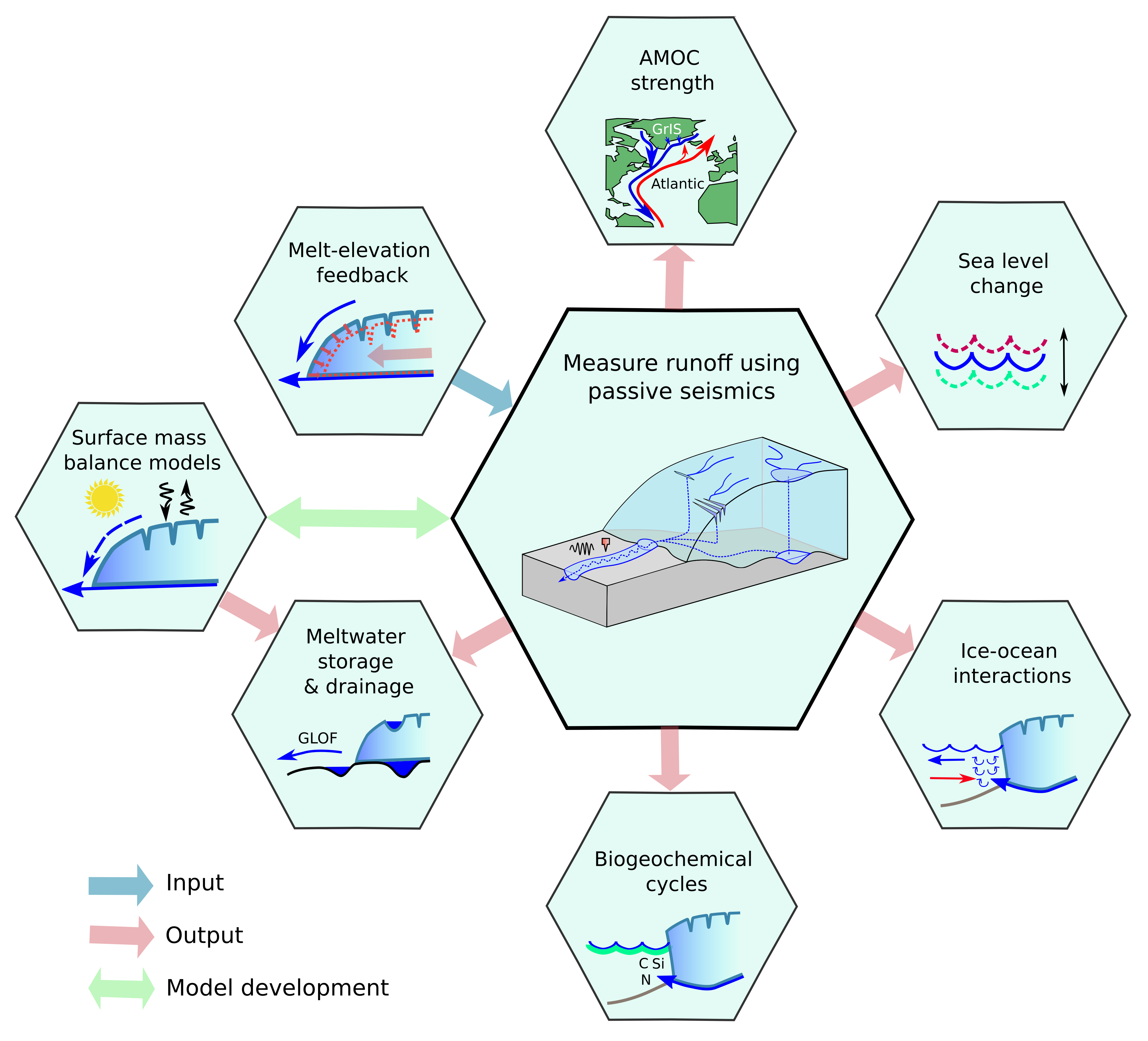
The GRuMPS project will deploy a network of seismic sensors in Greenland to measure runoff. Crucially, these seismic instruments are low-cost, less prone to damage compared to traditional river monitoring equipment, easier to deploy and can be used to monitor water flow under the ice sheet. In doing so we aim to move from the current sparse measurements restricted to land-terminating glacier margins with patchy temporal coverage, to systematic, continuous and near-real time monitoring of major glacier catchments around the Greenland Ice Sheet, including marine terminating glaciers. These data will provide critical inputs for climate, ice sheet and ocean models used to simulate climate tipping points.
The project's team is from the UK, France and Greenland and combines expertise in glacier hydrology and passive seismology with experience of building and deploying sensors in Greenland.
The GRuMPS project is part of a £81m funding package from the UK's Advanced Research and Invention Agency (ARIA) entitled Forecasting Tipping Points, which aims to enhance our climate change response by developing an early warning system for tipping points. A climate tipping point is a threshold beyond which certain ecosystems or planetary processes begin to shift from one stable state to another, triggering dramatic and often self-reinforcing changes in the climate system. Examples of this might include meltwater runoff affecting the Atlantic Ocean’s main ocean current system, which could in turn substantially cool Northern Europe.